Security
These two panels show the security wiring and the security events of the running application. The rule-based scans live in the Security, Pentesting, and Vulnerabilities advisors.
A score is not a certification
The security advisors score the evidence they could observe. When coverage is incomplete they show Results available with secondary Scan notes, and a partial 100 does not prove that unchecked controls passed. Failed, skipped, and UNKNOWN-only evidence cannot establish a score, even after dismissal. See score eligibility.
Spring Security
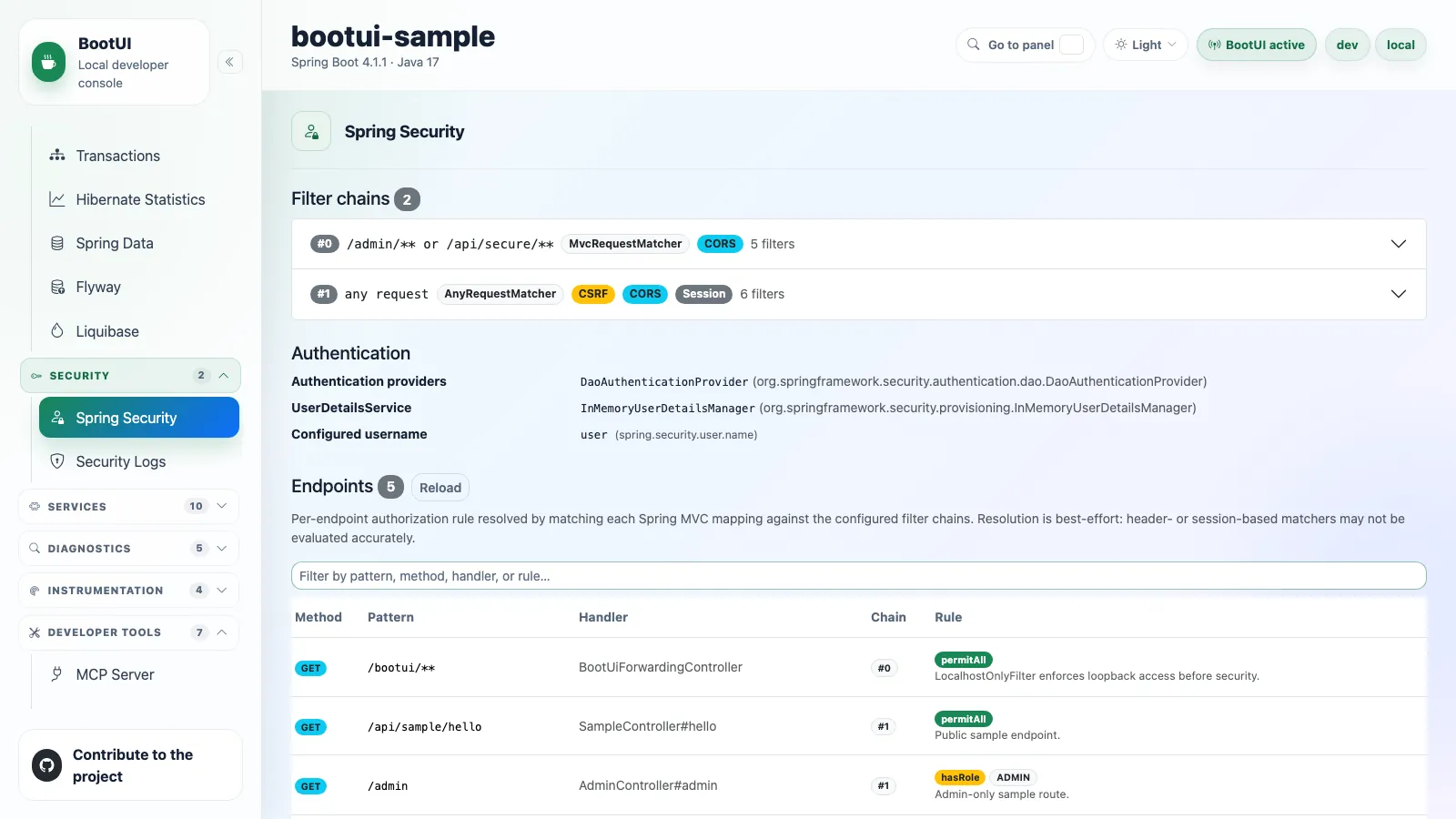
The Spring Security panel lists the application's filter chains and explains, on a best-effort basis, which rules apply to an endpoint. It describes local wiring. It does not expose credentials and does not replace a security audit.
On WebFlux the panel reads ordered SecurityWebFilterChain beans and lists their WebFilter pipelines. Chain matching stays fully non-blocking and uses each chain's own public reactive matcher.
What the WebFlux view cannot tell you
The explain and annotation-endpoint authorization views run against a sanitized exchange that carries only a path and a method. They never reuse the current request's headers, cookies, principal, session, body, or network metadata, and they mark reduced results as best effort rather than guessing context-dependent rules.
Functional RouterFunction routes are not listed. The compatibility sessionManagementPresent signal is labelled Security context and does not claim that WebSession persistence is configured.
Security Logs
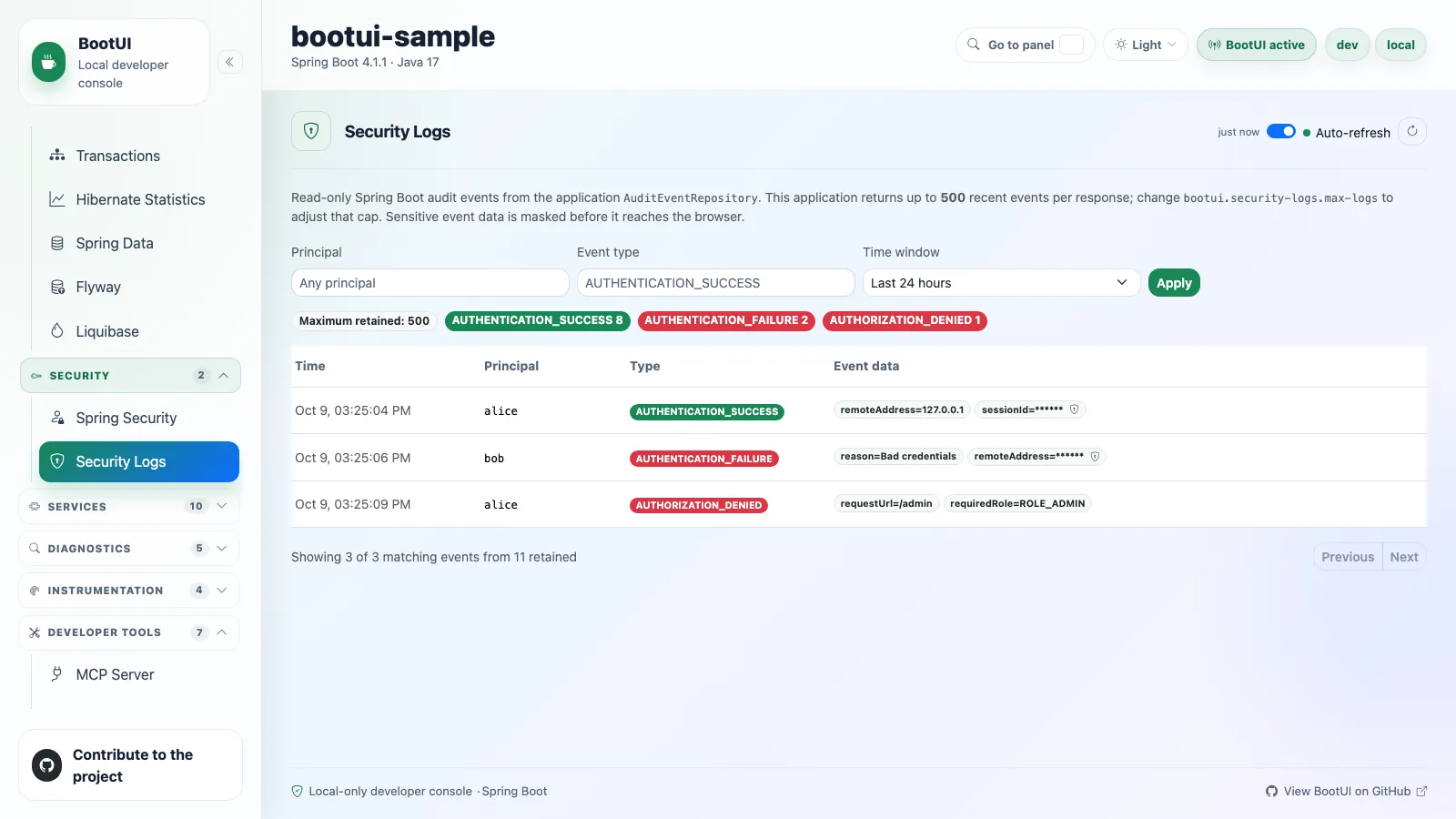
The Security Logs panel shows recent Spring Boot audit events, including authentication successes and failures and authorization denials, whenever Spring Security's audit listeners are active. You can filter by principal, event type, and time window. The panel summarizes retained event counts by type and masks sensitive data before rendering.
The list refreshes over Server-Sent Events. The browser subscribes to /bootui/api/security-logs/stream and re-fetches when the server signals a new audit event, instead of polling on a timer.
When the panel is enabled and the application has not defined an AuditEventRepository, BootUI contributes an in-memory one, which also lets Spring Boot create its standard audit listeners. Responses are bounded by bootui.security-logs.max-logs, which defaults to 500. Setting management.auditevents.enabled=false leaves the panel unavailable.
WebFlux behaves identically, because AuditEventRepository is framework-neutral: Spring publishes audit events through the ordinary ApplicationEventPublisher on both stacks.
On Quarkus
Events come from CDI security events (io.quarkus.security.spi.runtime.SecurityEvent) captured into a capped buffer rather than from an AuditEventRepository. This requires a security extension with quarkus.security.events.enabled=true; otherwise the panel reports unavailable with a clear reason.
Coverage is partial. Only authentication success, authentication failure, and authorization failure events are emitted, because Quarkus has no logout or session equivalent. Filtering, the type summary, masking, and the bootui.security-logs.max-logs cap are identical to Spring.