Advisors
BootUI's advisors run explicit, on-demand, rule-based scans and report severity-ranked findings together with their coverage limits. Each advisor is read-only and inspects one facet of the application: compiled architecture, the REST layer, the live Spring context, persistence, JVM memory, and security.
A usable assessment shows the same 0–100 Known-findings score in its own panel and on the Scorecard: 100 minus the weighted finding penalty. That number summarizes retained penalties. It is not a measure of application health or safety.
Reading every retained violation
Architecture, Hibernate, Spring (the Quarkus application advisor on Quarkus), REST API, Memory, Security, and Database keep their reports compact: violationCount is the real count, while sampleViolations is a preview, normally at most ten entries per rule.
When a rule has more findings than samples, choose View violations to read its first bounded page inline (100 by default). Larger sets use Previous and Next; Back to samples restores the preview. Opening a panel, receiving a report, and dismissing a rule never request detail pages. Detail reads work in read-only mode and never rescan.
Only the latest scan's details are retained, up to bootui.advisors.max-retained-violations (default 10000) across all rules of an advisor. When some counted details are missing, the panel says so through the retained count and a warning. Raising the limit needs a new scan to take effect. See the property reference.
Snapshot and retention
Each report has additive violationDetails metadata:
| Field | Meaning |
|---|---|
scanId | Opaque identity of the latest published scan; null before a completed scan. |
total | Concrete violations counted across all rules, before dismissal. |
retained | Number of sanitized detail entries retained across those rules. |
retentionLimit | Effective per-advisor limit frozen for this scan. |
truncated | Some counted details are missing from the retained index. |
locationNotes | Why some violation locations carry no source path; empty otherwise. |
While another scan is running, detail reads still refer to the previous completed snapshot; publishing its replacement changes the ID. Dismiss and restore change neither the ID nor the retained details. Retention completeness is not evidence coverage or score eligibility. truncated can also mean the source exposed only aggregate detail, as for Quarkus Security's QS-AUTHZ-004; BootUI never fabricates identities to fill that gap.
REST, MCP, and CLI retrieval
Read the cached report first, then pass its violationDetails.scanId with every page request. An MCP or CLI scan answers with a compact summary that carries the same violationDetails and at most ten topFindings; the REST scan still returns the full report.
GET <api>/<advisor>/rules/<encoded-rule-id>/violations?scanId=<encoded-scan-id>&offset=0&limit=100
| Advisor / REST root | MCP tool | CLI command |
|---|---|---|
architecture | get_architecture_rule_violations | architecture violations |
hibernate | get_hibernate_rule_violations | hibernate violations |
spring | get_spring_rule_violations | spring violations |
rest-api | get_rest_api_rule_violations | rest-api violations |
memory | get_memory_rule_violations | memory violations |
security | get_security_rule_violations | security violations |
database-advisor | get_database_advisor_rule_violations | db violations |
scanId and the rule ID are required. Offset defaults to zero and limit to 100, capped at 1000. See MCP and CLI for setup.
Examples, page shape, and errors
# Read only the cached report; this does not run a scan.
curl -s http://localhost:8080/bootui/api/architecture | jq '.violationDetails'
# Substitute the returned scanId, retaining the same value for every page.
curl -sG http://localhost:8080/bootui/api/architecture/rules/ARCH-SPRING-004/violations \
  --data-urlencode 'scanId=<returned-scan-id>' --data-urlencode 'offset=0' --data-urlencode 'limit=100'

bootui architecture violations ARCH-SPRING-004 --scan-id '<returned-scan-id>' --offset 0 --limit 100
{
  "name": "get_architecture_rule_violations",
  "arguments": {"id": "ARCH-SPRING-004", "scanId": "<returned-scan-id>", "offset": 0, "limit": 100}
}
The page contains scanId, ruleId, the full violationCount, retainedCount, truncated, sanitized violations, page: {total, matched, offset, limit, returned, hasMore}, and locations. page.total and page.matched count retained entries. To continue, set the next offset to page.offset + page.returned while page.hasMore is true, keeping the same scan ID, and still check truncated on the last page.
Invalid, blank, negative, fractional, or overflowing arguments are rejected. An MCP -32003 response-byte refusal is an error, not an empty page: retry the same scan ID and offset with a smaller limit. A missing or replaced snapshot returns 409; choose Refresh cached report (it never starts a scan), then View violations again. A rule id outside the advisor's catalogue answers Unknown advisor rule (REST 404, CLI-facade 400). Dismissed findings remain retrievable by ID. GraalVM/CRaC occurrences, Pentesting, and Vulnerabilities use different report models and are not covered.
Violation locations
Architecture, REST API, and Hibernate findings that name exactly one code element also say where it is. Each rule result carries sampleLocations aligned with sampleViolations, and each detail page carries locations aligned with violations; a null entry means that violation has no location. Findings that span several elements (package cycles, duplicate routes) and findings of other advisors keep no location. Nothing is parsed from the violation text or guessed.
In the panels, each row shows its location with a Copy location button, for example com.example.OrderService#place (OrderService.java:42). The Open locations in selector is a per-browser preference, off (None) by default; VS Code or IntelliJ IDEA turns each location with a source path into an editor link (vscode://file/… or idea://open?file=…). BootUI never opens an editor or a file from the server.
Location fields and where they come from
| Field | Meaning |
|---|---|
className | JVM binary class name, such as com.example.Outer$Inner or a Kotlin OrderUtilsKt file facade. |
memberName | Method, constructor (<init>), or field name; null for the class itself or a compiler-generated member. |
kind | CLASS, METHOD, CONSTRUCTOR, or FIELD. |
sourceFile | The source file name the class file records; a Kotlin facade or companion names its declaring .kt file. |
line | A positive line in that file, or null when unknown or not verifiable. |
sourcePath | The absolute local source path resolved during the scan, or null. |
precision | LINE when a line is known, MEMBER when only the member is, otherwise CLASS. |
- Architecture reads locations from ArchUnit's violating objects: the class, the member, and the line.
- REST API points at the handler method, exception handler, throwing endpoint, or controller class.
- Hibernate points at the entity class, the field or getter behind a mapped attribute, or a repository method. The JPA metamodel has no line numbers, so these stay at
MEMBERorCLASSprecision.
Source paths are resolved only during an explicit scan, through the Architecture advisor's bounded module and source-set lookup (see Generated application code). A class in a local Maven target/classes or Gradle build/classes directory maps to exactly one .java or .kt file. Classes read from an archive, other layouts, ambiguous matches, and an exhausted lookup budget keep a null path, and violationDetails.locationNotes says why. The lookup never follows symbolic links. Source paths describe the developer's own code, so they are not gated by the value-exposure policy.
A line is shown only when it belongs to the named member in the named file. Lines from Kotlin inlined code, past the end of the file, or from archive-read Kotlin classes drop to MEMBER precision rather than show a wrong one.
Score eligibility
A report is not automatically eligible for a score. SCANNED and PARTIAL reports can score when a valid severity summary accompanies known-severity findings or proven completed applicable checks. ERROR, DISABLED, and NOT_SCANNED never score, and malformed evidence stays unscored with an explanation. An empty summary, a rule registry size, or an all-skipped or all-failed report does not establish a clean assessment.
The penalties are fixed: CRITICAL 25, HIGH 10, MEDIUM 3, LOW 1, and INFO or NONE 0, clamped and rounded to 0–100. A partial 100 means no active penalties in the assessed evidence, not that unchecked work passed.
Advisor panels show Results available for usable scored results, with reasons in a collapsed Scan notes disclosure. The Scorecard shows Scan complete, Not scored, or Not applicable (confirmed empty scope) and an Open panel link. Advisor panels use neutral score colors; the Scorecard uses green, amber, and red at the 80 and 50 thresholds. See Scorecard.
The evidence object and eligibility rules
The backend's evidence object is the sole eligibility authority:
| Field | Meaning |
|---|---|
usable | At least one applicable check completed, or a genuine known-severity finding was observed, before filtering or dismissal. Genuine INFO and NONE findings can establish usability; informational missing-evidence notices and UNKNOWN-only vulnerability data cannot. |
coverageComplete | Applicable evidence is complete. Checks that do not apply are neutral; missing required observations and failures leave coverage incomplete. |
limitations | An immutable, bounded, sanitized list of explanations for incomplete coverage. |
The browser never reconstructs applicability. MySQL and Oracle checks on a PostgreSQL-only application stay neutral skipped diagnostics. A SCANNED report with usable: false and coverageComplete: true has no score and reads Not applicable, for example an Architecture import that found no classes. Legacy reports without valid evidence stay unscored.
Known-severity dependency findings establish usability before dismissal. A fully assessed package does too when every retained advisory has a known severity, or the result is genuinely empty, and both assessment.queryComplete and assessment.detailAssessmentComplete are true. UNKNOWN findings stay visible with no penalty, and UNKNOWN-only evidence stays unscored unless independent usable evidence exists. Dismissed known findings remain evidence while their penalties are removed. Inventory, query, and detail gaps qualify a score rather than suppressing it. EPSS never decides eligibility.
The last accepted report stays visible during a new request and when transport fails. A newly received report replaces it.
Single-flight scans
Expensive advisor actions are single-flight per scanner: a second tab, a Scorecard card, a REST caller, or an MCP tool cannot start a scanner while it is active. Duplicate requests fail immediately with the shared 409 busy response, and the panel keeps the last completed report visible. Different scanners remain independent.
Dismissing findings
Any finding can be dismissed when it does not apply to your project. Dismiss moves the rule into a collapsed Dismissed rules list and removes it from the finding count, severity bars, and known-findings score, in both the panel and the Scorecard. Restore it at any time from that list. Dismissal changes penalties, not application safety, observed evidence, or missing coverage. Controls are disabled while a scan or dismissal is pending, and when the panel is read-only or unavailable.
Where dismissals are stored
Dismissals are persisted under the dismissedRules node of a local .bootui/boot-ui.yml file (next to the runtime overrides file), so they survive restarts and stay consistent between each panel and the Scorecard. The file is developer-local and intended to be git-ignored. Rule identifiers are globally unique across advisors. Pentesting scan reports are not persisted: findings and dismissal flags reappear after you explicitly run the first scan.
bootui.overrides-file moves both files together, which lets dismissals survive a container image rebuild. See Persisting console state across image rebuilds.
Kotlin applications
The bytecode-driven advisors (Architecture, REST API, Hibernate) are Kotlin-aware without configuration and without adding kotlin-stdlib to your application. Behaviour is identical on all three stacks.
What Kotlin awareness covers
- Compiler-generated members and classes (
$defaultbridges, data-classcomponentN/copy,Companion,DefaultImpls,WhenMappings,FooKtfile facades) never appear as findings. - Suspending functions are judged on their declared signature: the
Continuationparameter is hidden andkotlin.Unitcounts asvoid. - A
lateinit varon an entity is not a public-field finding; a@JvmField varstill is. - Variants of a
sealed classexception hierarchy are not renaming findings. - Suppressing compiler noise never suppresses your code:
$defaultcalls are followed through, and a self-invocation in a lambda stays reported. - Recommendations offer the Kotlin equivalent, such as
openor thekotlin-springplugin and constructorvalinjection.
See Architecture checks, REST API checks, and Hibernate checks.
Architecture
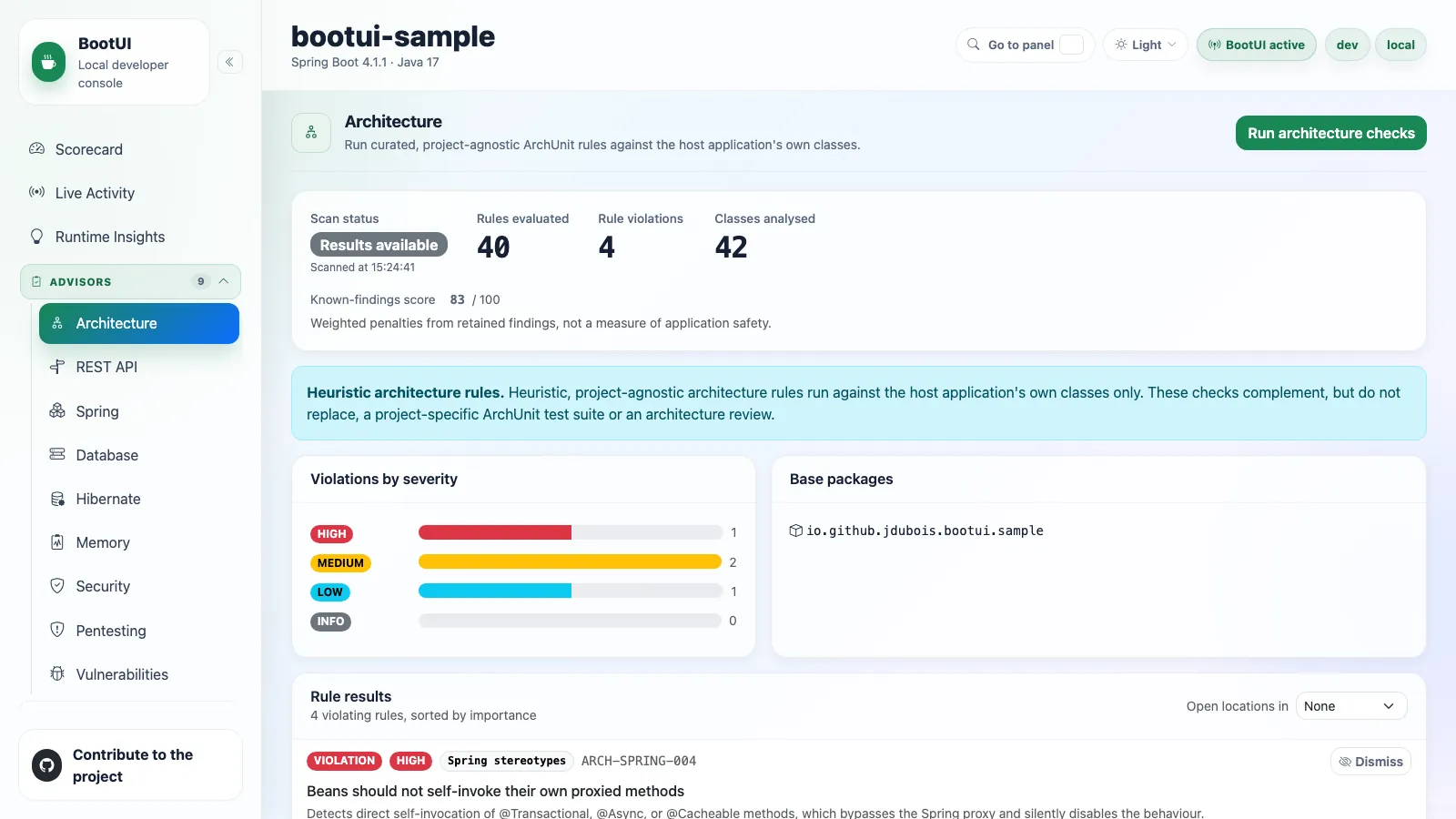
The Architecture panel runs a curated, zero-config ArchUnit ruleset against the host application's own compiled classes. It evaluates package cycles, general coding practices, and Spring stereotype and proxy heuristics (no field injection, correct layering, no self-invocation). See ARCHITECTURE-CHECKS.md for the full catalogue.
The scan runs on demand and caches its last report. The results list shows only violating rules, sorted by severity and violation count. Treat it as a starting point that complements a project-specific ArchUnit suite. Coding-practice checks (ARCH-CODE-*) exclude classes positively identified as generated; see generated-code scope and limitations.
Not available in GraalVM native images. The advisor scans compiled
.classfiles via ArchUnit'sClassFileImporter, which is incompatible with a native executable; the panel moves to the sidebar's Disabled / unavailable group and explains why.
On Quarkus
The panel runs the same ruleset and report contract. The java.util.logging check is skipped, standard-annotation field injection is reported at LOW, and Spring-only annotation rules find nothing. The Spring self-invocation rule is skipped because Arc supports intercepted self-invocation.
Quarkus has no @SpringBootApplication to read, so base packages are discovered at build time from the Jandex index. Discovery is single-module; the bootui.internal.base-packages key (comma-separated) overrides it.
REST API
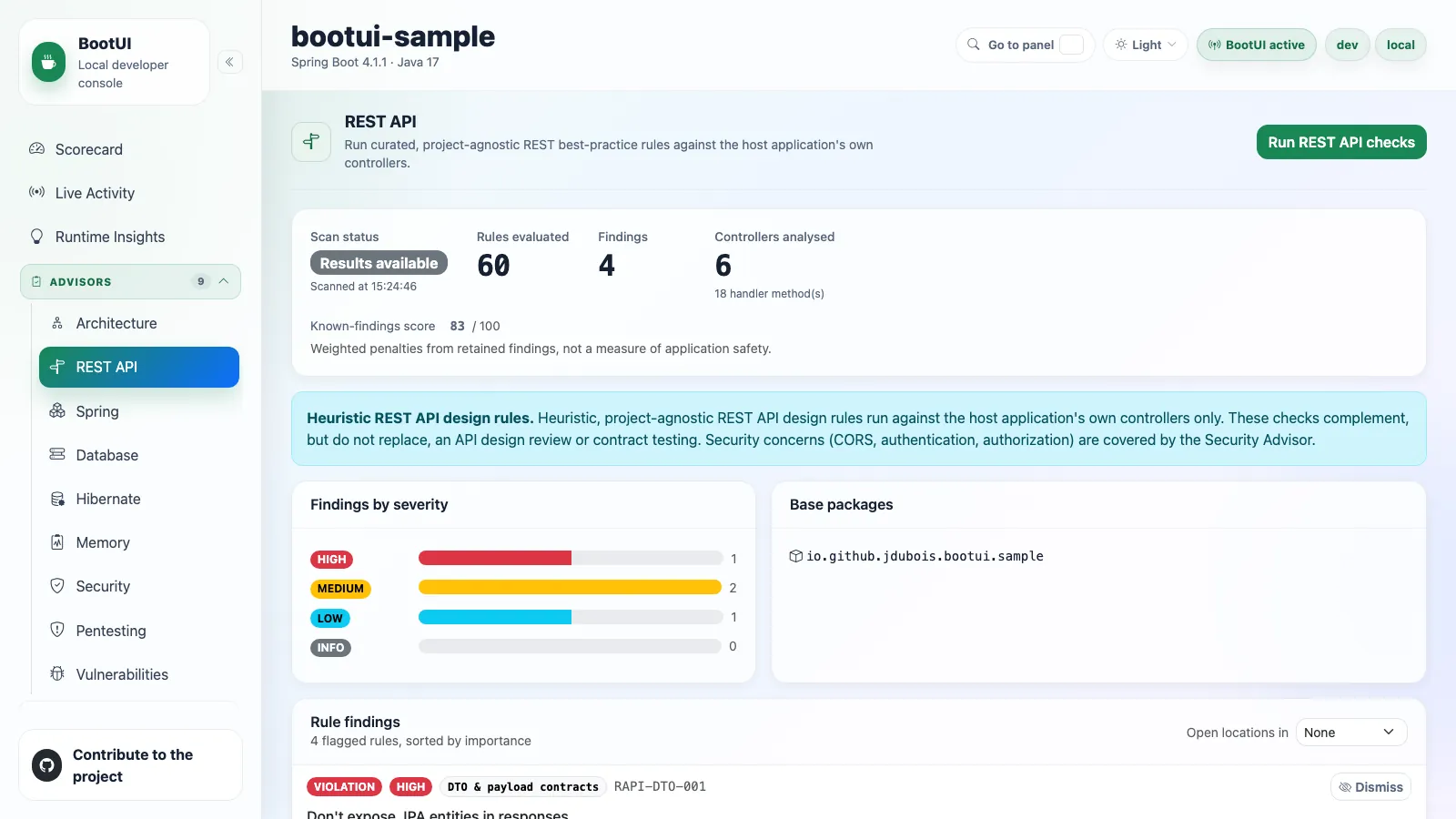
The REST API panel runs a curated, zero-config ruleset against the host application's web layer: @RestController / @Controller handlers on Spring, or JAX-RS resources on Quarkus. It derives a read-only model (methods, paths, parameters, return types, validation, declared throws) and evaluates 60 stable rule definitions across eight categories, of which 53 can emit a finding: routing, naming, status codes, validation, DTO contracts, pagination, versioning, and error handling and documentation. The RAPI-DOC-* rules run only when Swagger or MicroProfile OpenAPI annotations are present. Security concerns belong to the Security panel.
The scan runs on demand and caches its last report; the list shows only flagged rules. See REST API checks for the full catalogue.
Declared error contract
The panel also shows the application's declared error contract: every @ControllerAdvice / @RestControllerAdvice / @ExceptionHandler on Spring, and every Jakarta REST ExceptionMapper and Quarkus REST @ServerExceptionMapper on Quarkus. Each row names the handled exception type, the declaring method, the scope, the resolved precedence, the declared HTTP status, the response-body category, and the media types.
This is a pure declaration read: no handler is invoked and no request is synthesized, so anything the declarations cannot prove is reported as unresolved. Only the application's own declarations are listed. When a retained Exceptions-panel failure maps to exactly one declared handler, that panel links to the declaration here.
Cases reported as unresolved
- An advice that implements
Orderedchooses its position at runtime, so its whole precedence group is ambiguous. - A Spring handler without
@ResponseBodyrenders a view, so its body category is unresolved. - On Quarkus only
@Provider-annotatedExceptionMappers are listed. :::
Not available in GraalVM native images. The advisor scans compiled
.classfiles via ArchUnit'sClassFileImporter, which is incompatible with a native executable; the panel moves to the sidebar's Disabled / unavailable group and explains why.
Spring
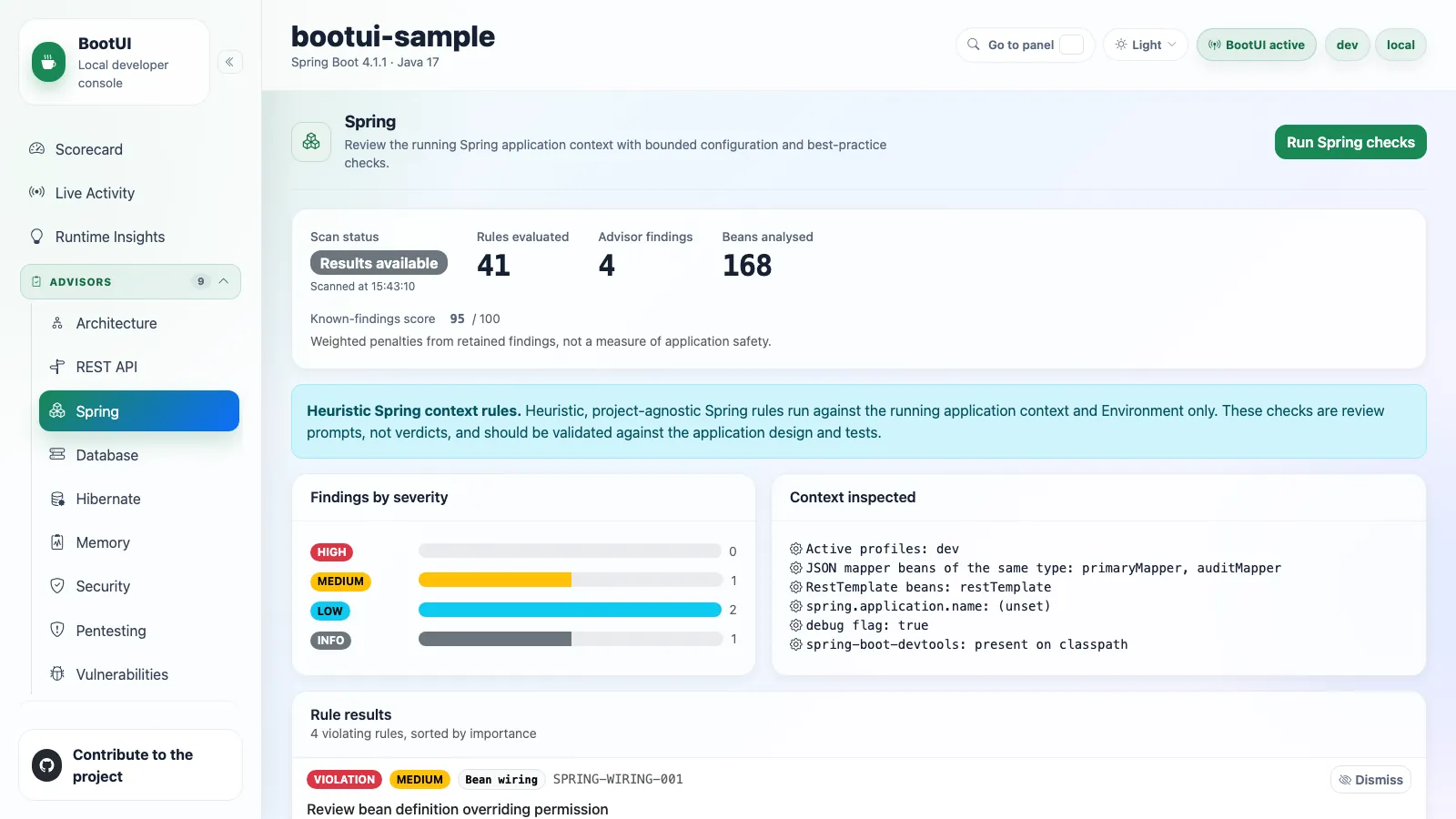
The Spring panel runs an explicit, read-only scan of the running Spring application context and Environment. It takes a bounded snapshot of selected bean groups and feature flags, then evaluates a curated ruleset across bean wiring, configuration hygiene, profiles, performance and concurrency (including virtual threads), web settings, data and persistence, Actuator exposure, and reactive (WebFlux-only) checks. See SPRING-CHECKS.md.
It focuses on "started but suboptimal" states and complements the Architecture panel by inspecting the live, wired context. It never mutates the context, intercepts traffic, or surfaces secrets. On MVC, Open Session in View is reported as present, confirmed absent, or unknown from actual registration metadata. This advisor is relabelled per framework: Spring on Spring Boot, Quarkus on Quarkus, with the same menu slot and /bootui/api/spring contract.
Quarkus
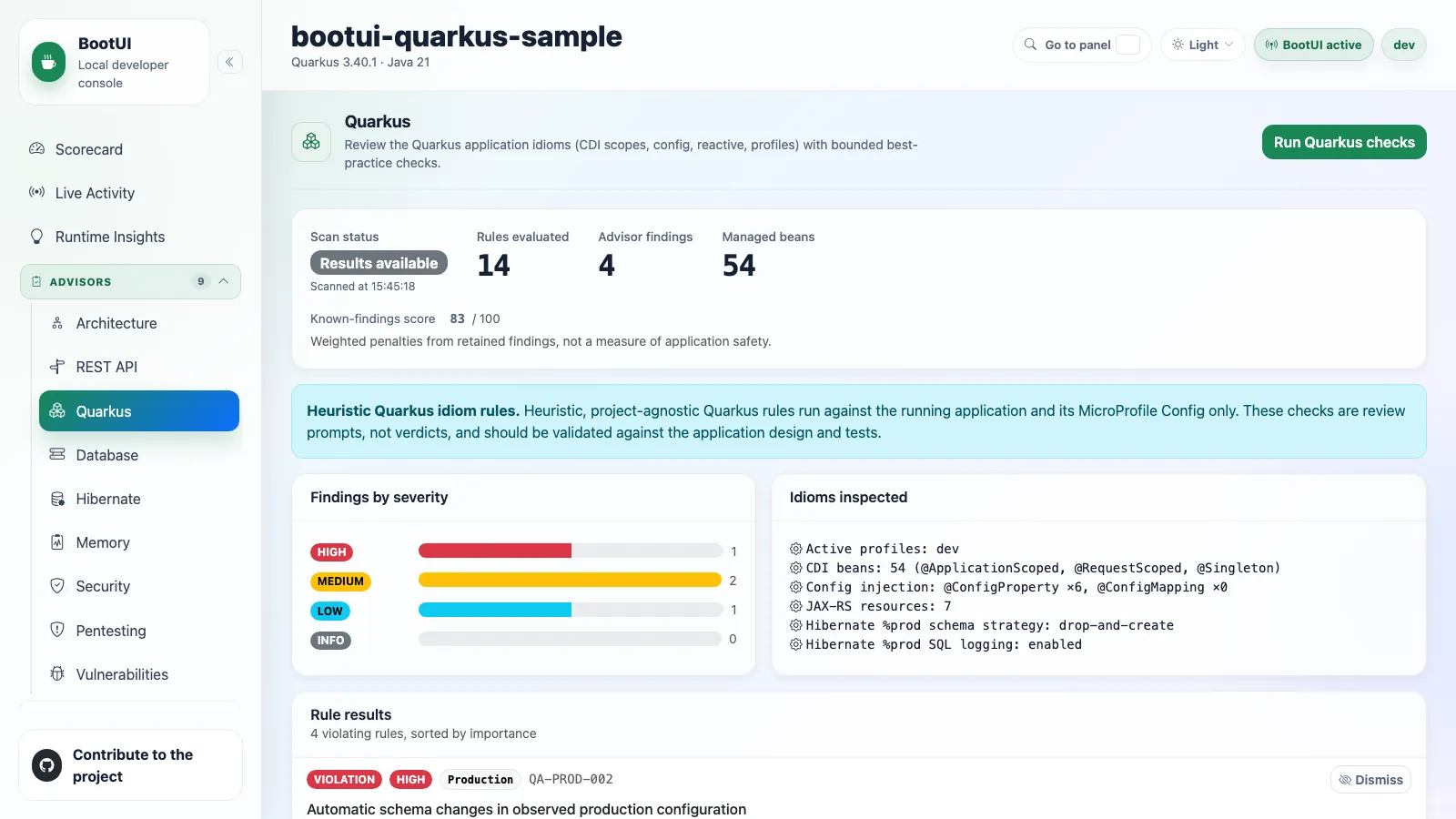
On the Quarkus adapter the framework-application advisor is relabelled Quarkus and runs a Quarkus-native ruleset against the running application and its MicroProfile Config:
- Resolved CDI/Arc scopes: public fields on normal-scoped beans and public state on singleton beans and REST resources.
- Production configuration evidence: schema actions, SQL and bind-parameter logging, explicit in-memory storage.
- Managed REST-client timers, HTTP compression, and request-draining configuration.
- Conditional synchronized virtual-thread pinning on JDK 21-23.
Missing annotations or production overrides are not defects by themselves, and incomplete evidence is reported explicitly rather than treated as clean. See QUARKUS-ADVISOR-CHECKS.md.
Database
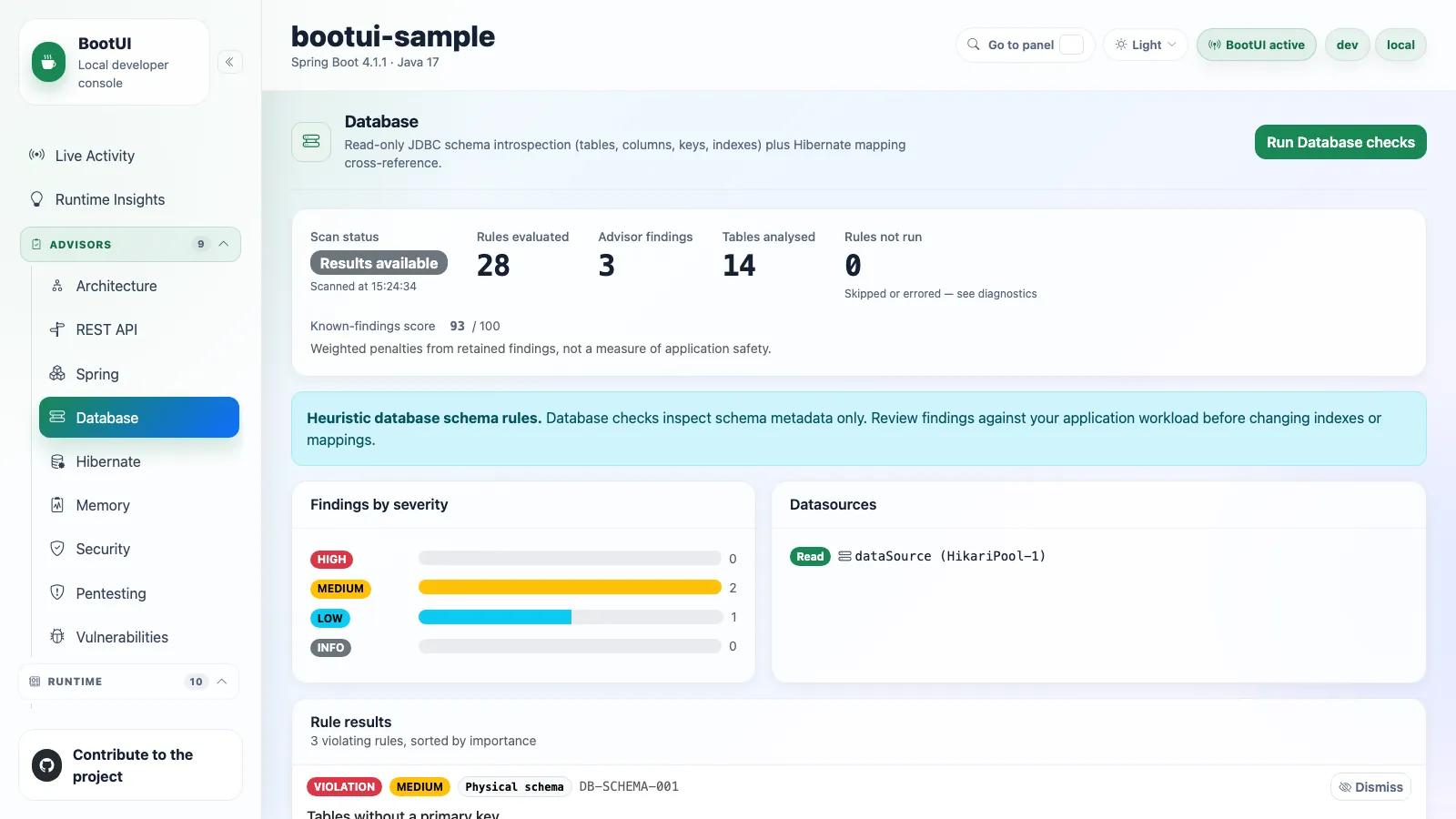
The Database panel introspects the physical schema of every discovered application DataSource through plain JDBC DatabaseMetaData (tables, columns, keys, indexes) and evaluates a fixed, on-demand ruleset of deterministic structural checks. It never executes DDL and never queries application data. See DATABASE-ADVISOR-CHECKS.md.
Each scan runs under fixed bounds (at most 300 tables, 300 columns and 100 indexes per table, a 20-second budget, a 5-second timeout per catalog statement) and reports what it could not do. Unreadable datasources, truncated scans, and skipped or errored rules appear as statuses and diagnostics, never as passing checks. Credentials in JDBC URLs and driver errors are redacted.
| Status | Meaning |
|---|---|
SCANNED | Everything was read completely |
PARTIAL | Something was not read |
ERROR | Discovery failed or no schema could be read |
DISABLED | Successful discovery found no datasource |
For PostgreSQL, MySQL, MariaDB, and Oracle (19c+), dialect-specific catalog checks run in addition to the generic ones. Every other database (H2, SQL Server, and so on) still runs the full generic ruleset. When a Hibernate metamodel is available, the panel also cross-references the physical schema against mapped JPA entities, and skips that half with a stated reason otherwise.
The generic structural checks
- A missing primary key, excluding framework-generated one-row identifier tables.
- A physical foreign key without a known leading-column access path, as a contextual review.
- Exact ordinary-index definition overlap, not merely a shorter leading prefix.
- A foreign-key column whose type disagrees with the column it references.
- A redundant unique index duplicating the primary key.
- Duplicate foreign-key constraints.
- A narrow auto-generated primary key.
- A MySQL invisible, MariaDB ignored, or Oracle invisible index that writes still maintain. :::
What each dialect adds
PostgreSQL:
- Invalid or broken indexes.
- A sequence nearing exhaustion, measured against the smaller of its own maximum and its owning column's capacity.
- Constraints currently not validated.
- A table publishing updates or deletes with no usable replica identity.
- An
UNLOGGEDtable or leaf partition.
MySQL/MariaDB:
- Tables on a non-transactional storage engine.
- The legacy three-byte
utf8mb3character set. - An
AUTO_INCREMENTcounter nearing its column type's capacity.
Oracle:
- Unusable indexes, including per-partition status.
- Disabled or unvalidated constraints.
- A non-cycling sequence or identity generator nearing exhaustion.
The dialect comes from DatabaseMetaData.getDatabaseProductName(), the version string, and the JDBC URL; MariaDB is detected as its own dialect even through the MySQL driver, and an "Oracle" product name is confirmed against v$version before Oracle checks run. Oracle reads use only ALL_* views and SYS_CONTEXT, with no ojdbc dependency in BootUI. Partitioned tables are reported once on the parent.
What the Hibernate cross-reference checks
- An explicit association without a matching physical foreign-key constraint, excluding
NO_CONSTRAINT. - An explicit declared table or column name not observed in the scoped metadata.
- Supported nondefault nullability mismatches, not guessed Java-to-JDBC type mappings.
- A declared
@Column(length=...)longer than a bounded physical string column. - A positive
@Column(precision=..., scale=...)wider than a bounded physicalDECIMAL/NUMERICcolumn. - A mapped unique constraint with no physical index that enforces it.
- An explicitly named
@IdwithGenerationType.IDENTITYwhose PostgreSQL/MySQL/MariaDB column reports no auto-increment, identity, default, or generated value.
Only entities with an explicit @Table(name = ...) are cross-referenced. These are declaration-versus-observation reviews, not validation of the effective runtime mapping, since the advisor reads only the standard JPA metamodel and does not resolve the physical naming strategy. A mapped name matching tables in several datasources is treated as ambiguous. The panel proposes no query-based optimizations, execution-plan analysis, or index suggestions from usage.
On Quarkus
The panel is identical, over the same report contract. DataSource beans are discovered through @Any Instance<DataSource> and de-duplicated by the physical pool behind BootUI's SQL Trace wrapper. Datasource names come from the Agroal @DataSource("...") qualifier, read reflectively so no io.agroal type is linked; otherwise they fall back to positional names (default, datasource-2). The Hibernate cross-reference needs quarkus-hibernate-orm.
Hibernate
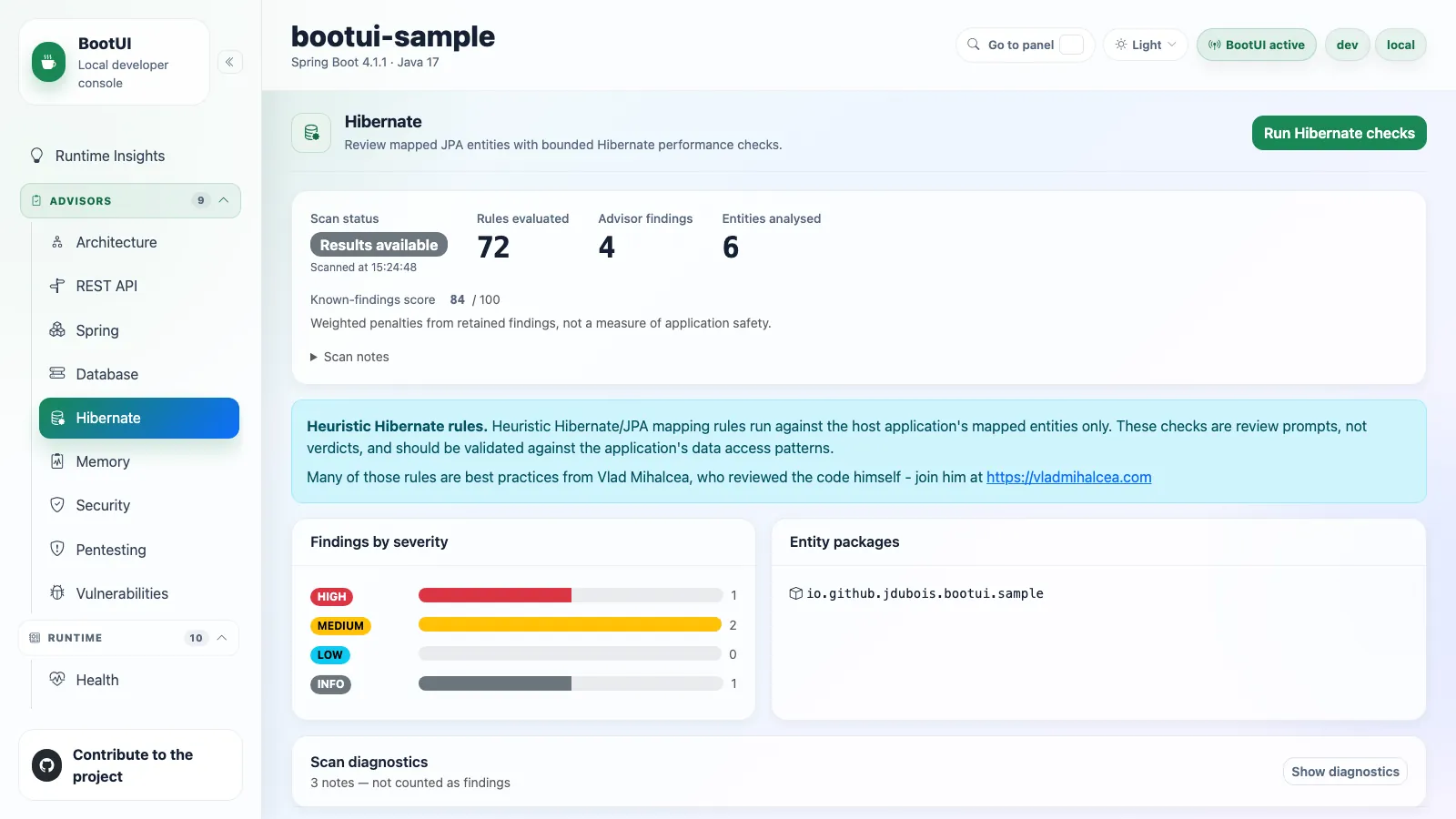
The Hibernate panel runs an explicit, read-only scan against the JPA EntityManagerFactory metamodel when Hibernate ORM is present. It reviews mapped entities, persistence-unit observations, and Spring Data JPA repository metadata for common performance and mapping risks: eager fetching, problematic identifier generators, collection fetch pagination, unsafe cascades, cache misconfiguration, and risky ddl-auto values. It never intercepts queries, invokes repositories, executes SQL, or modifies mappings. See HIBERNATE-CHECKS.md.
The catalog has 72 active rules. Unavailable observations and rule failures yield PARTIAL while keeping valid findings, and the report's diagnostics (Scan diagnostics in the panel) names every failed or incompletely evaluated rule. A finding whose rule was only partly evaluated carries a coverageNote. An empty findings list is not proof that every mapping or query was verified.
On Quarkus
The panel runs the same 72-rule registry when quarkus-hibernate-orm is present, discovering entities from the live EntityManagerFactory across all persistence units. Spring Data query rules skip when repository metadata is unavailable. Differences:
- Effective factory settings are unit-scoped. Named units do not inherit the first factory's values.
- Bytecode enhancement is always enabled, so known-absent-enhancement findings do not fire.
- Panache active-record entities are handled specially (see below).
| Spring / native Hibernate key | Quarkus equivalent |
|---|---|
ddl-auto / hbm2ddl.auto | quarkus.hibernate-orm.schema-management.strategy (*) |
show-sql | quarkus.hibernate-orm.log.sql |
format_sql | quarkus.hibernate-orm.log.format-sql |
batch_size | quarkus.hibernate-orm.jdbc.statement-batch-size |
default_batch_fetch_size | quarkus.hibernate-orm.fetch.batch-size |
jdbc.time_zone | quarkus.hibernate-orm.jdbc.timezone |
generate_statistics | quarkus.hibernate-orm.statistics |
query.in_clause_parameter_padding | quarkus.hibernate-orm.query.in-clause-parameter-padding |
query.fail_on_pagination_over_collection_fetch | quarkus.hibernate-orm.query.fail-on-pagination-over-collection-fetch |
cache.use_query_cache / cache.use_second_level_cache | quarkus.hibernate-orm.second-level-caching-enabled (single unified toggle) |
(*) In Quarkus 3.33.3.1, an explicitly configured deprecated quarkus.hibernate-orm.database.generation takes precedence. Quarkus/Jakarta create is create-only, while Hibernate hbm2ddl.auto=create is destructive; the advisor preserves that difference.
With verified Panache transformation, the public-persistent-field finding does not fire, and the id field of Panache's base entity is ignored by the @GeneratedValue check.
Memory
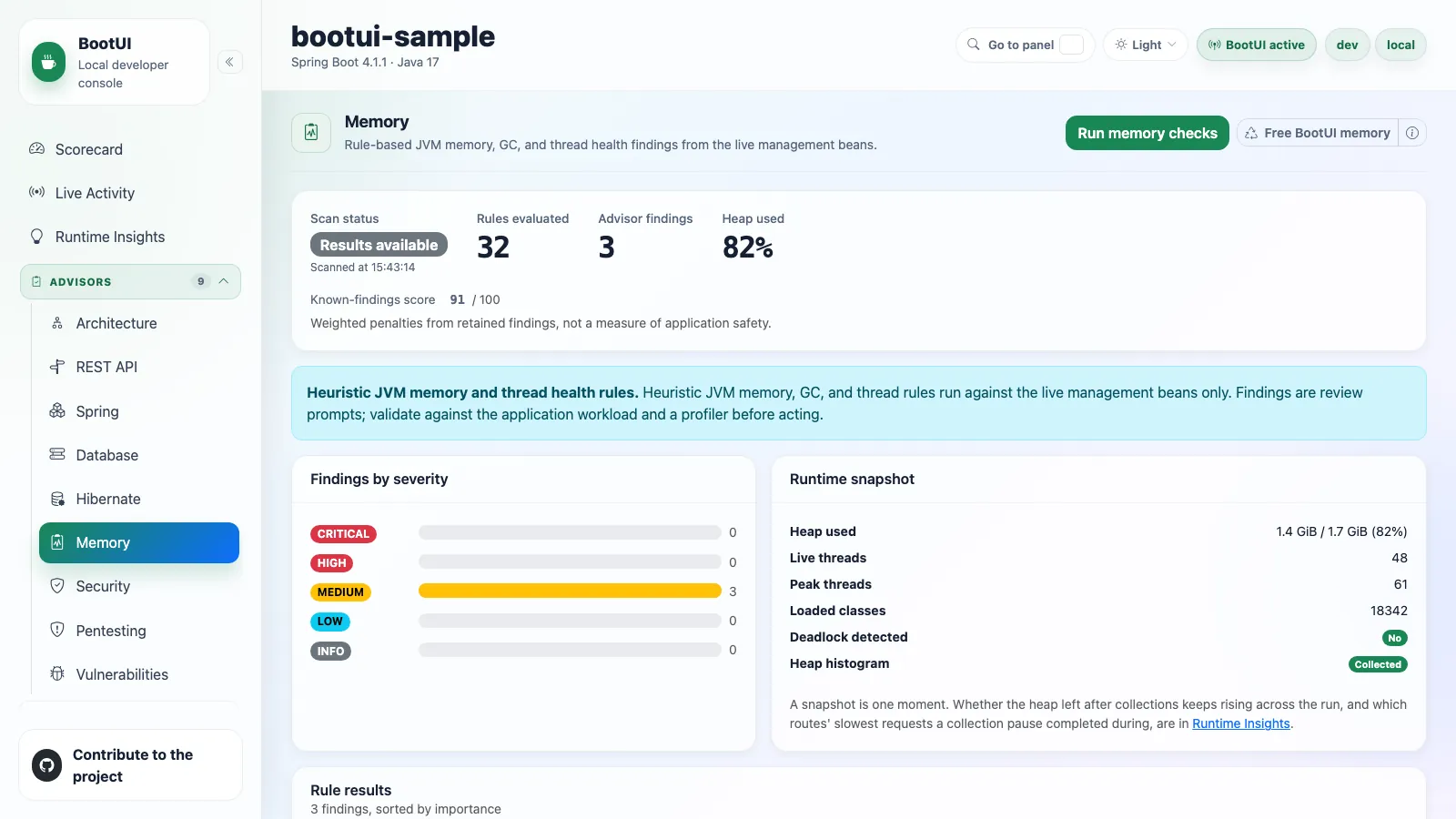
The Memory panel runs an explicit, read-only scan over the live JVM management beans: heap and memory pools, garbage collection, threads, loaded classes, and an optional class histogram. It reports severity-ranked findings such as heap pressure, metaspace saturation, native-footprint risk inside a container, lifetime GC overhead, thread deadlocks, and collection bloat. It complements the Live Memory and Threads panels by diagnosing the data they expose. The scan is on demand and caches the last report. See MEMORY-CHECKS.md. The shared Free BootUI memory header action drops BootUI's own buffers and requests a GC before you re-run the checks.
Security
The Security panel runs an explicit, read-only scan of the application's security configuration to flag hardening gaps across authentication, authorization, CSRF, sessions, transport and headers, CORS, method security, actuator exposure, OAuth2 resource-server validation, and configuration hygiene. It never intercepts live traffic, exposes credentials, keys, or session identifiers, or modifies the configuration. The same panel and /bootui/api/security contract support all three stacks.
Spring Boot (Spring Security)
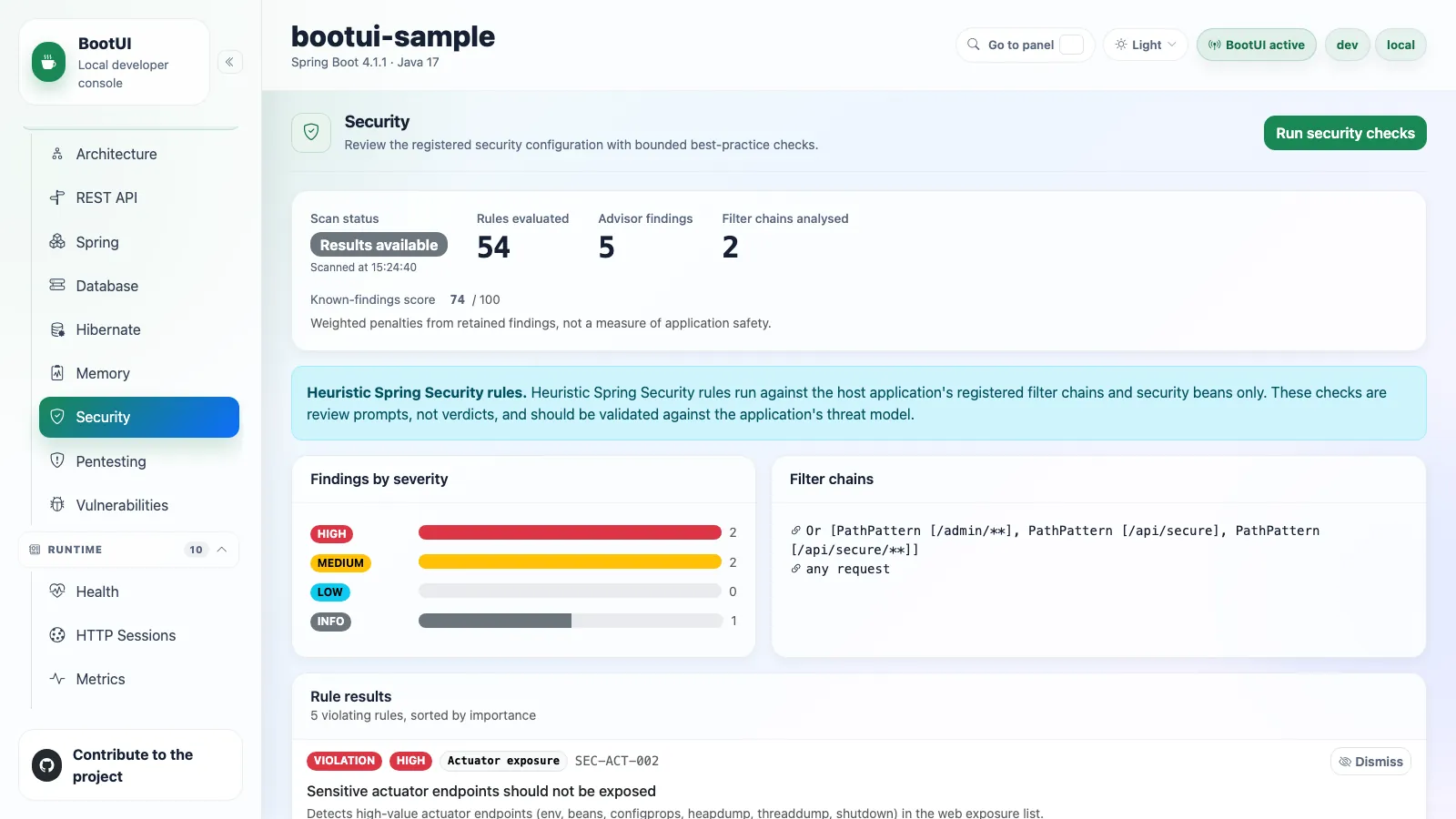
On Spring Boot it analyses Spring Security when present: already-created SecurityFilterChain configuration and supported metadata, without executing authorization managers, custom matchers, or credential providers. Unsupported evidence stays incomplete rather than becoming a verdict. See SECURITY-CHECKS.md.
Spring WebFlux
On WebFlux it evaluates a dedicated 26-rule SEC-RXF-* catalogue over SecurityWebFilterChain beans, reactive CORS/OAuth2 beans, and security-relevant configuration, excluding BootUI's own permit-all chain.
On Quarkus
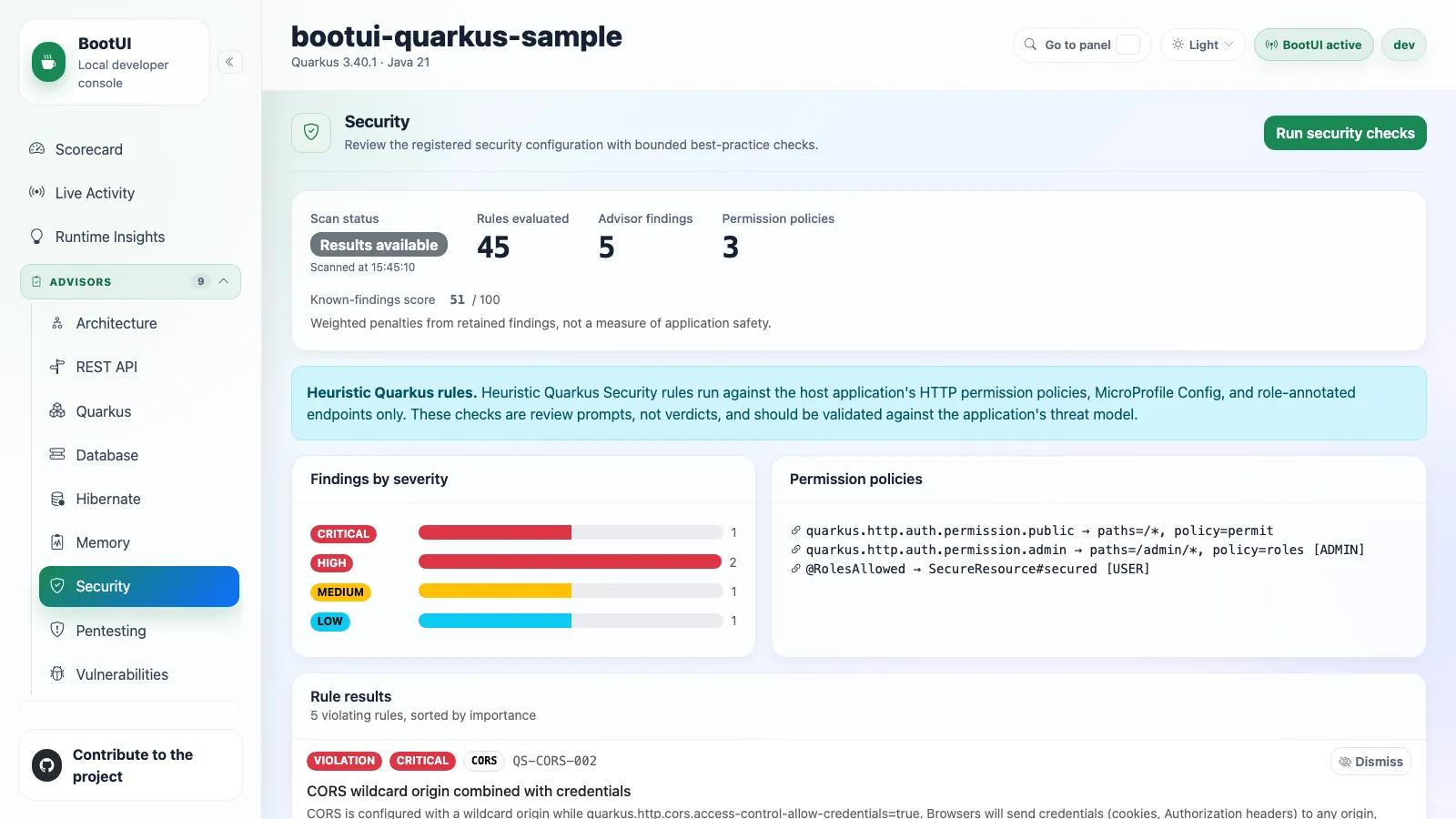
On Quarkus it runs a Quarkus-native ruleset over the HTTP permission policies, MicroProfile Config, and annotated endpoints: Elytron/OIDC authentication, quarkus.http.auth.permission.* authorization, TLS and transport policy, forwarded-header proxy trust, CORS (including the wildcard-origin-with-credentials trap), response headers, and @RolesAllowed, @PermissionsAllowed, and @AuthorizationPolicy. The UI relabels metrics ("Permission policies" in place of "Filter chains"). See QUARKUS-CHECKS.md.
Pentesting
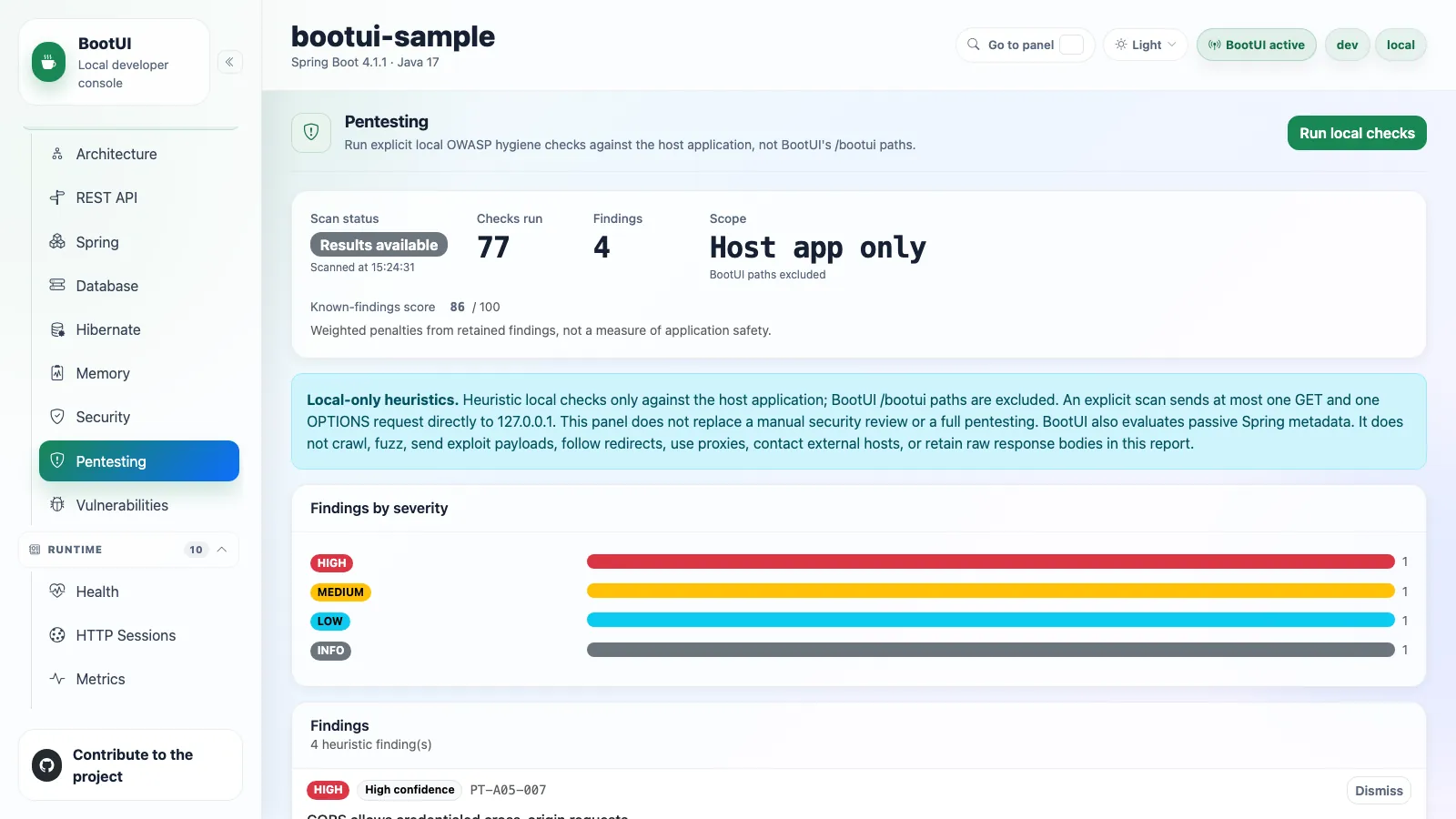
The Pentesting panel runs explicit, local-only OWASP Top 10 2025 hygiene checks against the host application, not BootUI's /bootui routes. A scan combines bounded framework metadata with at most one GET and one OPTIONS request to literal 127.0.0.1 under the application context path; the client never follows redirects or uses proxies. Checks cover browser-document headers, CORS, cookie flags, verbose errors, Spring Security wiring, actuator exposure, and common Spring Boot hardening gaps. Quarkus CORS, OIDC, and TLS are reviewed by the Security panel instead.
It never crawls endpoints, sends SQL/XSS/destructive payloads, contacts external hosts, or includes raw response bodies, cookie values, credentials, or full issuer URLs. Findings are heuristic review prompts, not proof of exploitability.
The 77 active checks each carry a stable PT-* identifier, OWASP 2025 category, evidence source, and recommendation. The panel shows Findings by severity. Failed or bounded-away evidence produces a PARTIAL scan. See PENTEST-CHECKS.md. Pentesting supports the shared dismiss/restore workflow by exact PT-* ID; dismissal does not dismiss an equivalent Security advisor finding.
Per-stack coverage
- Spring MVC is the complete reference collector.
- Spring WebFlux contributes Spring configuration and OAuth metadata, but reports MVC mapping and servlet-filter evidence unavailable. Its reactive Security advisor owns
SecurityWebFilterChainroute policy. - Quarkus runs the same scanner and supplies its port, root path, CORS, OIDC, and HTTP-listener TLS configuration, while marking Spring endpoint metadata unavailable. Local HTTP does not assess proxy-edge HTTPS.
Unsupported checks never become a false clean result.
Vulnerabilities
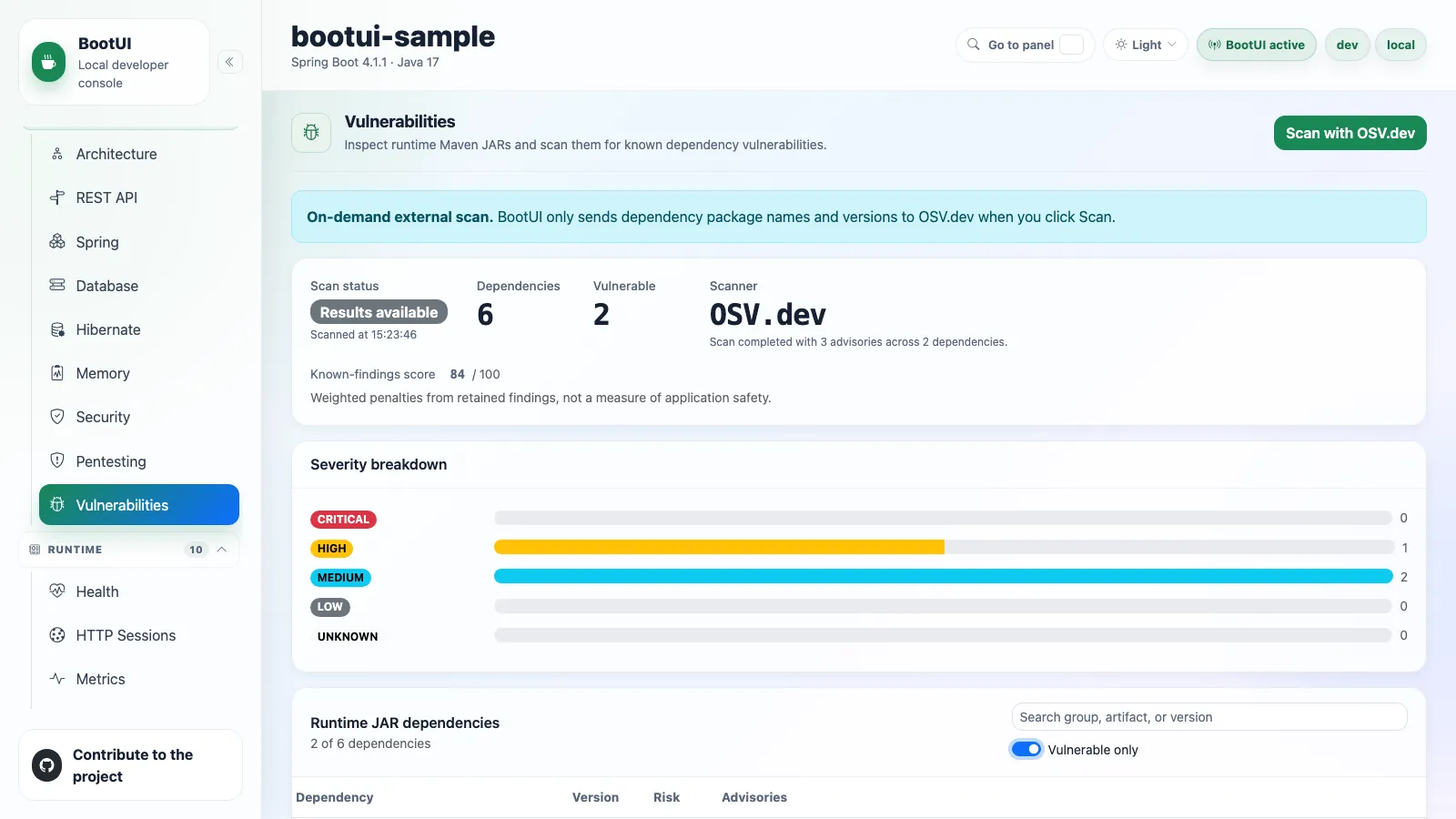
The Vulnerabilities panel shows the locally discovered dependency inventory and explicit OSV.dev lookup results, to identify known-vulnerable dependencies in the running project. Findings are ordered by severity (dismissed findings sink to the bottom), then alphabetically. OSV is contacted only on the user-initiated scan. bootui.vulnerabilities.osv-enabled=false disables scanning and bootui.vulnerabilities.epss-enabled=false disables EPSS enrichment, on both adapters.
The Vulnerabilities checks catalogue documents the interpretation rules and sources. A completed lookup is not proof of application safety or complete runtime discovery. Panel and Scorecard share the evidence-based eligibility.
An agent's vulnerabilities_scan answers with a summary of at most ten vulnerable dependencies. get_vulnerabilities_report lists limit dependencies (10 by default), each with at most 5 advisories without details; an exact group:artifact query lists all of one dependency's advisories, and an exact advisory id or alias returns that advisory whole.
Severity scoring
Severity is derived from OSV's severity[] entries: BootUI computes CVSS_V4 and CVSS_V3 vectors, preferring v4 when both are valid, and never treats a bare number as CVSS. CVSS 0.0 is NONE. An advisory with neither a parseable score nor a database_specific label renders as UNKNOWN. A malicious-package advisory (OSV MAL- ID) is always CRITICAL: removing the dependency, not upgrading it, remediates it.
How a CVSS score is selected and parsed
BootUI matches the exact Maven ecosystem and groupId:artifact, and evaluates the installed version against explicit versions and supported Maven ECOSYSTEM ranges. Applicability is matched, not matched, or unresolved; unsupported or malformed evidence never becomes an unaffected verdict. A positive OSV query keeps the finding as PARTIAL even when detail association is unsupported or contradictory.
It takes the highest valid v4 score across applicable package assessments, and only when none is valid the highest valid v3 Base score. Top-level severity is a fallback only when no applicable package severity is supplied. A recognized database_specific.severity label remains a compatibility fallback, otherwise UNKNOWN. MODERATE maps to MEDIUM.
v3.0/v3.1 vectors follow the FIRST CVSS v3.1 specification (Base metrics only). v4.0 vectors are scored with a port of FIRST's reference calculator; a supplied Threat metric such as E:U yields the CVSS-BT score, and supplemental metrics never change the score. Invalid segments, unknown metrics, and duplicates are rejected. CVSS v2 is not calculated.
OSV querying and robustness
Withdrawn advisories are excluded. A failed advisory-detail fetch does not abort the scan: it is counted, the scan degrades to PARTIAL, and every advisory that did fetch is kept.
Pagination, batching, and result validation
The scanner follows OSV's next_page_token on /v1/querybatch, bounded by 20 page rounds per chunk (degrading to PARTIAL at the bound). The package list, already bounded by bootui.vulnerabilities.max-packages, is split into batches of at most 1,000 queries, OSV's hard limit. Detail fetches run with bounded concurrency (up to 10) and a configured advisory-detail cap. Request timeouts are not a whole-scan deadline.
Responses are validated, and malformed results fail visibly instead of reading as a clean scan. A later failure preserves earlier pages as PARTIAL; failure before any valid page is ERROR, with the local inventory retained.
EPSS enrichment
Each advisory whose id or aliases include a CVE-* id is enriched with EPSS data from FIRST.org's free API: the modeled probability of exploitation in the next 30 days and its percentile. It renders as a secondary badge next to the severity badge (for example "2.3% EPSS"), using the highest available per-CVE probability. This is a prioritization heuristic, not a combined exploit likelihood. A failed or unreachable EPSS request never fails the scan or discards OSV results.
Fix availability
Each advisory carries fixedVersions and fixAvailable. A candidate must be a fixed event closing a supported Maven interval containing the installed version, be newer under Maven ComparableVersion ordering, and be unaffected across all matching entries. Git/SEMVER ranges and last_affected/limit boundaries supply no upgrades. A false signal or empty list means no target was established, not that the dependency is safe or that no upstream fix exists. Candidates are upgrade evidence, not guarantees of publication or compatibility; BootUI does not install them.
Dismissing a vulnerability
A vulnerability can be dismissed like any other finding (see Dismissing findings). Because it is scoped to one dependency, the key is <vulnerability id>::<package name> (for example GHSA-xxxx-xxxx-xxxx::org.example:sample). Dismissing a finding for one dependency never hides the same advisory on another, and a dismissal survives a patch-version bump of the still-vulnerable dependency. Dismissed vulnerabilities stay visible (dimmed, with a Restore button) and leave the vulnerable counts. Controls are disabled when read-only.
How Spring discovers dependencies
The Spring adapter resolves coordinates from three sources, in decreasing authority:
- The embedded CycloneDX SBOM (
META-INF/sbom/application.cdx.jsonorMETA-INF/sbom/bom.json). Maven PURLs carry thegroupIdno manifest header carries. A component declared not shipped (scope: "excluded", or thecdx:maven:package:test=trueproperty) is left out unless the archive census finds its JAR. META-INF/maven/*/*/pom.propertiesdescriptors on the classpath, including inside a repackaged archive's nested JARs.java.class.pathentries, read through the Maven repository layout or an adjacent POM. A group id is derived from a path only when a literalrepositorydirectory makes it unambiguous. Inside a repackaged fat JAR this source is dead.
Unreadable resources, a malformed SBOM, and unreadable archives are logged and skipped rather than failing the inventory.
Runtime reach
With the BootUI agent's inventory sensor recording this run, the dependency table gains a Runtime reach column and filter: whether each dependency's jar loaded classes in this JVM, and whether a class an advisory names did. It is a prioritization hint that never changes a finding's severity, score, counts, or Scorecard penalty. Without the agent, or while the Code Inventory panel is disabled, the column is absent and the table says why.
| Reach | Meaning |
|---|---|
| Named class loaded | A class the advisory names loaded from this dependency's own jar. This means "a class the advisory mentions loaded", never "the vulnerable code ran". |
| Loaded | Classes of the jar loaded in this run, with the route of the request that first loaded one (while HTTP Exchanges is visible). |
| Not loaded yet | No class of the jar loaded in this JVM, and the evidence could have shown it. It may still load later. |
| Unknown | The evidence cannot tell, with the reason: the recorder is not running, the jar was not found or holds no classes, it is shaded, or the agent never records its classes. |
How reach is decided
The agent keeps, per jar, a bounded set of class-name hashes (8,192 per jar, 65,536 in all; past that, a class the advisory names reads as unknown, never as not loaded), for JDK types only, so no class loader is pinned. Dependencies are matched to jars as the Code Inventory panel matches them. Names come from the advisory's structured OSV fields, else from fully qualified class names in its summary and details, marked from the advisory text; text names are looked for only in the dependency's own jar, so their absence says nothing.
Coverage
A coordinate-based inventory can only scan what it can name, so the panel also reports what it couldn't. BootUI takes a census of the application's real archives (BOOT-INF/lib/ or WEB-INF/lib/ entries, or JARs on java.class.path and application-classloader URLs) and attributes each to a resolved coordinate. The java -Djarmode=tools -jar app.jar extract --layers --launcher layout is supported on Spring MVC and WebFlux. The census does not recursively search directories, extract nested JAR contents, or contact remote URLs.
coverage.status | Meaning |
|---|---|
COMPLETE | The provider reports every enumerated archive identified or first-party; this is not independent verification of the runtime inventory. |
INCOMPLETE | Some archives were neither; they are counted and named, and the panel warns that they were not scanned. |
UNAVAILABLE | Neither the classpath nor the application classloader exposes enumerable archives (for example under a native image), so coverage is unknown rather than claimed. |
When coverage is incomplete, the panel shows an "Unidentified JARs" metric and a warning with a collapsible list of archive names and a pointer to adding the CycloneDX plugin. Packages beyond bootui.vulnerabilities.max-packages (default 500) are counted in scan.packagesSkipped and shown as a warning.
First-party module JARs and spring-boot-jarmode-tools
Two kinds of archive are never in an SBOM yet are not a coverage gap, so Spring MVC and WebFlux inspect an unidentified archive (manifest and entry names only) before reporting it:
- First-party module JARs. An archive with at least one class, all of them in the application's base packages, is counted in
coverage.archivesFirstPartyand named incoverage.firstPartyArchives(at most 200). It is not scanned. The check fails closed: a single class outside the base packages, a resource-only archive,META-INF/maven/descriptors, a bundled.jar/.war/.zip, or no detectable base package keeps it unidentified. When the Spring Bootlayers.idxdefines anapplicationlayer, only archives in that layer can be first-party. spring-boot-jarmode-tools. Added by Spring Boot's build plugins at packaging time, so it is absent from the SBOM. When its file name, manifest title and version agree and every class is underorg/springframework/boot/jarmode/tools/, it is identified asorg.springframework.boot:spring-boot-jarmode-toolsand scanned.
With both, a multi-module application built with an SBOM reports COMPLETE coverage.
On Quarkus
The panel is identical and uses the same report contract and workflows. The one difference is dependency discovery: the inventory is captured at build time from the resolved runtime dependency model and needs no SBOM. Coverage is COMPLETE only when that model was captured and decoded whole; a missing or blank model, a malformed entry, or an unencodable coordinate reports UNAVAILABLE, keeping every readable dependency.
Known limitations
- Discovery can overclaim coverage. Spring de-duplicates archive basenames and matches filenames without group identity, so case or classifier ambiguity can overstate identification.
- Without an SBOM, some JARs cannot be identified. No JAR manifest header carries a
groupId, so artifacts published without a Maven descriptor (Spring Framework, Spring Boot,tomcat-embed-*,hibernate-core, and others) cannot be resolved. They appear through coverage as unidentified. - Shaded/uber JARs are invisible. The inventory is coordinate-based, so a library relocated inside a shaded JAR is not seen.
- No direct-vs-transitive provenance. "Introduced through" is not tracked on either adapter.
- Evidence is bounded, not exhaustive. Distinct advisory IDs can count the same CVE more than once, and a whole-scan deadline is not implemented. Browser version sorting is lexical for same-package rows.