Improve usage with Chronicle
Review token efficiency, agent turnaround and output quality, then choose one evidence-backed workflow change.
What you will learn
Review workshop history with Chronicle while respecting privacy. Balance token usage, task completion time and result quality, then choose one evidence-backed workflow improvement without weakening tests or review.
Review your workshop sessions
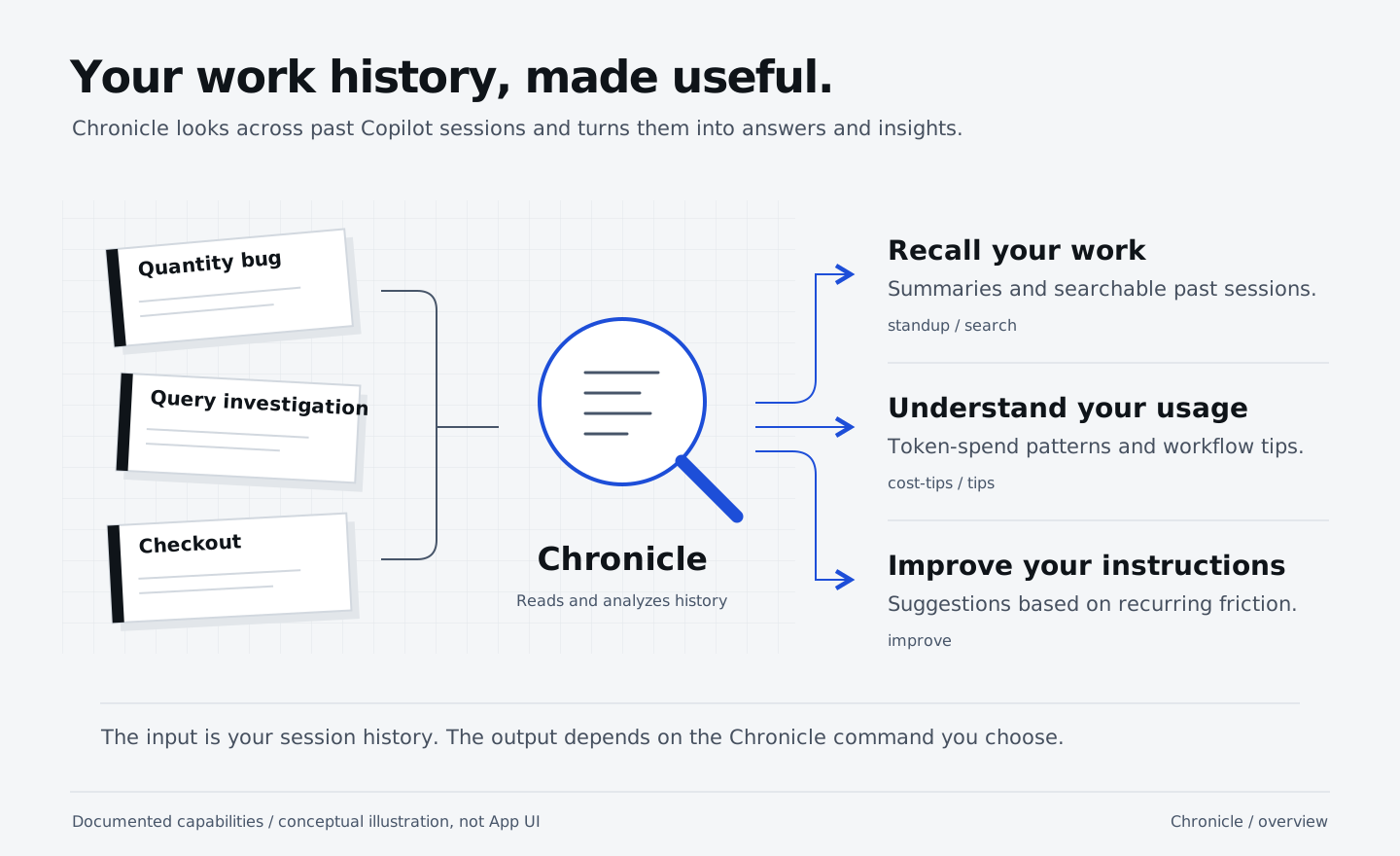
You have fixed a bug, generated a feature, polished the UI, investigated a query problem, coordinated parallel work, requested a critique and delegated checkout implementation. Use Chronicle in GitHub Copilot App to find patterns across those sessions: what helped, what caused rework and what you could improve.
Goal: balance token economics, turnaround time and quality, not simply use fewer tokens. Preserve tests, review and permission boundaries.
Decide before analyzing history
Chronicle can access history across repositories. Running usage tips may start that analysis immediately: a later workshop-only prompt cannot undo prior access. Before running it, decide whether you are comfortable with the history it may use. A repository name or a request to filter the report does not restrict which history the command can access.
You may opt out. If the accessible history is unsuitable, or you cannot verify an offered pre-execution scope control, do not launch the analysis. Review your workshop transcript locally instead, choose one better prompt, and record “Chronicle not run: privacy choice.” You can complete this exercise by reviewing the transcript instead. Do not project personal history on a classroom screen.
Open Chronicle if you opted in
Create a new App session in your workshop repository and name it Cart: Chronicle. The App creates a new worktree, but this read-only analysis does not use it. Leave Cart: mock checkout and its verified worktree unchanged; no app restart is needed. A fresh session does not restrict history access.
Review the current repository over the past seven days; you do not need to enter dates or list session names or IDs. Exclude this Chronicle session.
In the new session’s App composer, not a terminal, send the command and request as one message:
/chronicle tips Review all workshop sessions for the current repository
over the past seven days, excluding this Chronicle session and unrelated work.
State the repository, resolved time range/timezone and sessions used.
Suggest up to three improvements covering token efficiency, agent turnaround
time and output quality, grounded in observed examples. Explain trade-offs.
Preserve tests, review and permission boundaries. Report only available metrics
with units and coverage; mark missing data unknown. Do not infer currency or edit files.
Use tips for this broader workflow review. cost-tips is an optional
token-spend drill-down; you do not need to run both.
If Chronicle is unavailable in your build, review your workshop transcript locally instead and record “Chronicle not available.” Scope wording does not restrict history access. Check the returned scope; if unrelated work appears, stop and do not share it.
Understand the recommendations
| Lens | Evidence to look for |
|---|---|
| Token economics | Repeated broad reads, oversized logs or unnecessary skill loading. Narrow the investigation and load guidance on demand. |
| Agent turnaround | Repeated corrections, duplicate investigation or avoidable serial handoffs. Improve the brief or agree on interfaces before delegating. |
| Output quality | Missing acceptance cases, UI/API mismatch or stale review evidence. Strengthen the contract and verification. |
These are patterns to look for, not findings every report must contain. A longer initial brief or an additional review may use more tokens but reduce rework and improve the result. Choose model and effort for the task, not on the assumption that more effort always improves quality.
Here, performance means completing tasks faster with fewer corrections. Chronicle reviews how you work with Copilot, not how fast the shopping cart responds. Check the application separately with tests and HTTP/SQL measurements.
Use recorded agent execution time when available, excluding time spent waiting for human input.
Distinguish tokens, credits and cost
Input/output/cache counts, when available, describe token usage for the reported
scope. /context, where exposed, describes the active window—not total workflow
consumption. Credits, model-weighted usage and billed currency are different
quantities. Preserve Chronicle’s labels and units; do not turn an unexplained
cost field into dollars.
Fusion can make additional calls. Do not infer complete Fusion accounting from the main conversation alone. Missing usage is unknown, not zero. The same applies to the rubber duck and five-subagent exercise: include their usage only if exposed, and distinguish five assignments from five simultaneous agents. More agents are not proof of lower cost or better quality. Caching can change cost without changing task quality or raw token counts.
Change one habit
On the worksheet, record: observation → supporting session/example → next action → checks retained. For example, replace “fix the cart” with the reproduction, relevant endpoint, acceptance criteria and exact regression command.
Choose one recommendation and record the expected token, time or quality benefit and its trade-off. Use that improved brief for the final review, keeping the same tests and evidence requirements. Different tasks are not controlled comparisons; usage or timing differences do not prove an improvement. For this exercise, use existing sessions rather than creating extra comparison runs.
If history is not available yet, use the actual workshop transcript to identify a repeated read or unclear prompt and mark Chronicle “not observed.” A new account may not have enough history; record usage as unavailable rather than guessing figures. Run the analysis once, not after every message, because the analysis itself also consumes resources.
Ask Copilot to suggest one short repository instruction for a recurring problem you identified. Record it as a suggestion for now; do not edit the verified main checkout or silently add commits after checkout delivery. If you explicitly choose to apply it, use a new follow-up feature branch. That change needs its own review, publishing/merge approval, PR and verification. For local recovery, preserve the checked result and create a normal branch before any separately approved edits. Describe expected benefits as predictions until you measure them. Session-history advice is not a performance benchmark or proof of code quality.
Continue with the final review and handoff.
What you have learned
- Review workshop history with Chronicle or a local transcript, respecting privacy.
- Balance token usage, task completion time and result quality rather than assuming fewer tokens means better work.
- Choose one improvement supported by session examples: refine a prompt or propose a repository instruction, keeping tests and review unchanged.