Review with rubber duck
Ask the built-in rubber duck agent to challenge the combined implementation before final handoff.
What you will learn
Use Copilot App’s rubber duck agent for an independent critique, assess its findings and distinguish a review from permission to apply corrections.
A critic, not another implementer
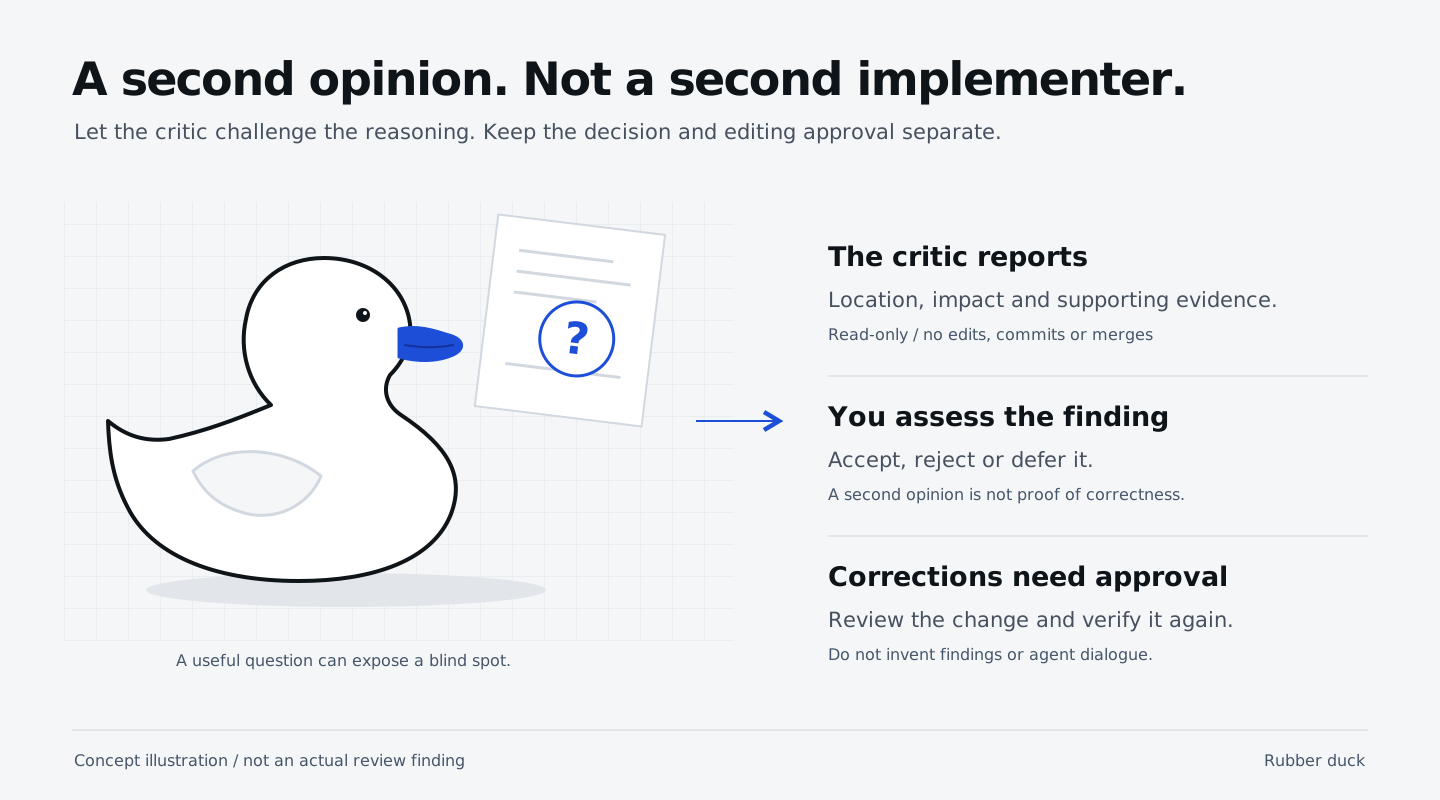
Traditional rubber ducking means explaining your code to expose mistakes in your reasoning. Copilot’s built-in rubber duck agent talks back: it reviews a plan, implementation or tests and reports meaningful problems. It does not edit the code itself.
Copilot selects a different critic model when a suitable one is available. You do not need to open another project session or manually choose the critic model. A second opinion can catch blind spots, but it is not proof of correctness. See the rubber duck guide.
Challenge the combined result
Stay in Cart: boundary tests, on the verified combined result from the
previous chapter. If you used local recovery, keep that recovered checkout;
do not switch back to incomplete remote main. Use Interactive.
Use workshop-start, the tag you created during setup, as the review’s starting point.
Type /rubber-duck in the App composer, not a terminal, with this request:
/rubber-duck Review the full shopping-cart change from workshop-start
to this checked result, including the quantity fix, removal, Canvas UI
changes, query optimization and both parallel contributions.
For this review only, I approve a read-only independent critic despite the
starter's no-agents restriction. Keep AGENTS.md and all other restrictions unchanged.
Look for concrete behavior regressions, missing edge-case coverage,
incorrect prices/totals and evidence that does not match the code.
Keep the existing acceptance criteria. Do not edit files, run the app,
change branches, commit, push or merge.
Report each meaningful finding with its file/location, impact, supporting
evidence and suggested correction. Mark unverified assumptions explicitly.
Return the actual critic's findings, or explain why it could not run.
Inspect the agent activity and returned critique. Do not count a main-agent summary as an independent review unless the critic actually ran.
Decide what to do with the findings
Ask the main Copilot agent to explain which findings it accepts, rejects or needs more evidence for. Check the cited code yourself. Do not add a defect just to make the demonstration interesting, and do not accept style-only suggestions as blocking regressions.
If a finding needs correction, authorize that correction separately.
Ask Copilot to prepare a normal follow-up feature branch from this checked
result before editing; never commit on the verification checkout or push
directly to main. Keep the existing Cart: boundary tests session.
Review the corrected diff, run the full suite and repeat the affected preview.
Any follow-up PR needs its own review and merge approval.
On the normal path, use Create PR for the correction, targeting your own
main. Merge and verify that PR, preserving the correction branch, before
starting the fresh checkout session from verified main.
If you used local recovery, keep the corrected local branch and record
delivery as blocked; do not switch to incomplete remote main.
If you defer a finding, record the reason and continue from the previously
verified result without applying that correction.
Done when: you have an actual critique, a decision for each actionable finding and evidence for any correction you accepted. Record that on the worksheet.
If the command or critic model is unavailable
Check the App’s / picker. You can also ask “Rubber duck this implementation”
in the same composer. If no independent critic can run, use a facilitator’s
demonstration or an ordinary review and record the limitation. Do not describe
a single-model reread as a different-model critique or broaden account permissions.
The next exercise is different: instead of critiquing this implementation, you will start a fresh Cart: mock checkout session and coordinate five child App sessions to build mock checkout in parallel, after approving the shared contract: four writers and one read-only reviewer, each in a separate worktree. Their work forms one checkout PR.
What you have learned
- Request an independent critique through /rubber-duck, without opening another session.
- Assess concrete findings against code and acceptance criteria rather than treating the critic as an authority.
- Separate review from editing and merge permission, and verify accepted corrections on a normal feature branch.